
Shanghai dialects
The local dialect that prevails in Shanghai is the modern Wu – today's southern Jiangsu province – dialect of the Taihu Lake area, which is the inheritance and development of the ancient Wu dialect. Nowadays, the Shanghai dialect varies within five dialect areas in terms of their ancient tones – Chongming, Liantang, Songjiang, Jiabao (Jiading and Baoshan), and the downtown area.
Throughout Shanghai's history, the population and settlements of residents in the downtown area have been quite complicated. In addition to the prevailing Shanghai dialect, other dialects such as the Ningbo, Shaoxing, Suzhou, Wuxi, and northern Jiangsu dialects, as well as Cantonese are still used in Shanghai and have ongoing influence today.
Municipal flower and emblem
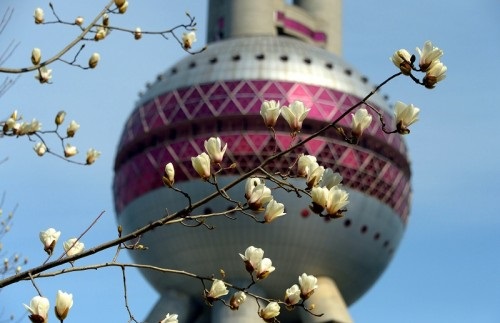
The white magnolia was approved as the flower of Shanghai by the Standing Committee of the Shanghai Municipal People's Congress in 1986. As a magnolia species, the white magnolia blossoms in early spring with big, spotless white petals pointing upward. It was chosen as a symbol of the pioneering and aspiring spirit of Shanghai's people.

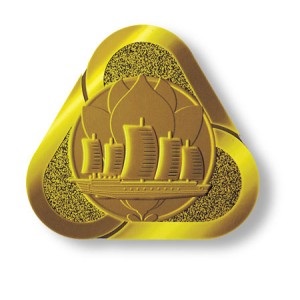
The city's emblem design was approved by the Standing Committee of the Shanghai Municipal People's Congress in 1990. It is a triangular symbol consisting of a white magnolia flower, a large sand junk, or Chinese boat, and a propeller. The triangle emblem is in the form of a ship propeller, symbolising the continuous advancement of the city. In the middle of the emblem, a large sand junk with its sail set is one of the oldest vessels plying the waters of Shanghai Port and represents the city's long history as a port city. The large sand junk is set against a white magnolia flower blossoming in early spring to symbolise the energy and vitality of Shanghai.

 Back
Back
 Touch More